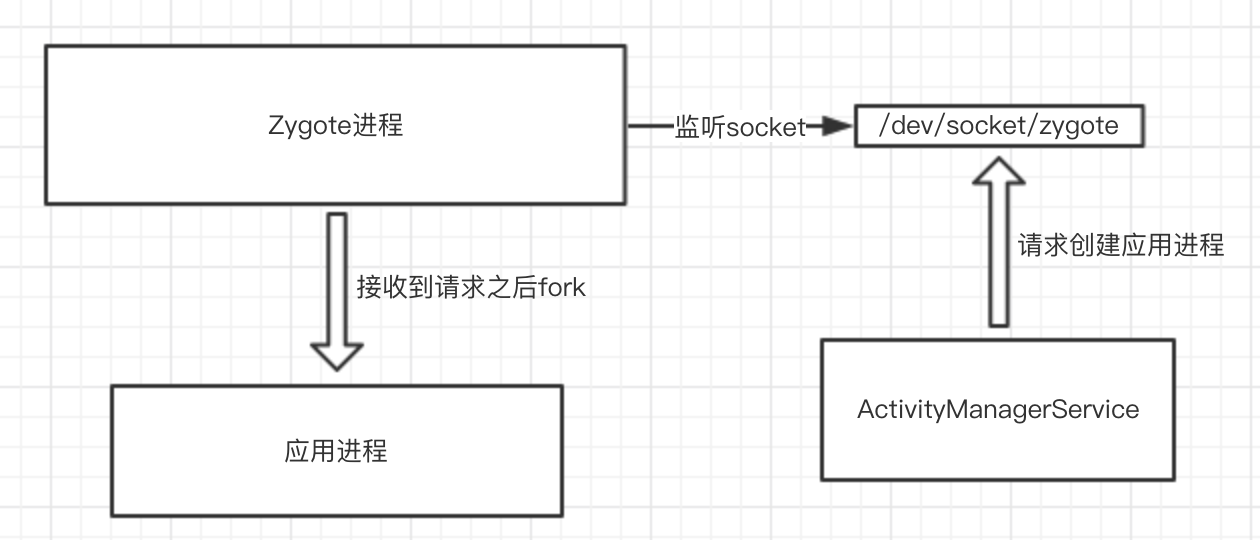
public class Process {
    ...
    private static final String ZYGOTE_SOCKET = "zygote";
    ...
    public static final ProcessStartResult start(final String processClass,
                                                final String niceName,
                                                int uid, int gid, int[] gids,
                                                int debugFlags, int mountExternal,
                                                int targetSdkVersion,
                                                String seInfo,
                                                String[] zygoteArgs) {
        ...
        return startViaZygote(processClass, niceName, uid, gid, gids, debugFlags, mountExternal, targetSdkVersion, seInfo, zygoteArgs);
        ...
    }
    ...
    private static ProcessStartResult startViaZygote(final String processClass,
                                                    final String niceName,
                                                    final int uid, final int gid,
                                                    final int[] gids,
                                                    int debugFlags, int mountExternal,
                                                    int targetSdkVersion,
                                                    String seInfo,
                                                    String[] extraArgs)
                                                    throws ZygoteStartFailedEx {
        ...
        return zygoteSendArgsAndGetResult(argsForZygote);
    }
    ...
    private static ProcessStartResult zygoteSendArgsAndGetResult(ArrayList<String> args) throws ZygoteStartFailedEx {
        openZygoteSocketIfNeeded();
        ...
        sZygoteWriter.write(Integer.toString(args.size())); 、
        sZygoteWriter.newLine();
        int sz = args.size();
        for (int i = 0; i < sz; i++) {
            String arg = args.get(i);
            if (arg.indexOf('\n') >= 0) {
                throw new ZygoteStartFailedEx("embedded newlines not allowed");
            }
            sZygoteWriter.write(arg);
            sZygoteWriter.newLine();
        }

        sZygoteWriter.flush();

        // Should there be a timeout on this?
        ProcessStartResult result = new ProcessStartResult();
        result.pid = sZygoteInputStream.readInt();
        if (result.pid < 0) {
            throw new ZygoteStartFailedEx("fork() failed");
        }
        result.usingWrapper = sZygoteInputStream.readBoolean();
        ...
    }
    ...
    private static void openZygoteSocketIfNeeded() throws ZygoteStartFailedEx {
        ...
        sZygoteSocket = new LocalSocket();
        sZygoteSocket.connect(new LocalSocketAddress(ZYGOTE_SOCKET,
        LocalSocketAddress.Namespace.RESERVED));
        ...
    }
}
int loopCount = GC_LOOP_COUNT; while (true) { int index;
/* * Call gc() before we block in select(). * It's work that has to be done anyway, and it's better * to avoid making every child do it. It will also * madvise() any free memory as a side-effect. * * Don't call it every time, because walking the entire * heap is a lot of overhead to free a few hundred bytes. */ if (loopCount <= 0) { gc(); loopCount = GC_LOOP_COUNT; } else { loopCount--; }
try { fdArray = fds.toArray(fdArray); index = selectReadable(fdArray); } catch (IOException ex) { throw new RuntimeException("Error in select()", ex); }
if (index < 0) { throw new RuntimeException("Error in select()"); } else if (index == 0) { ZygoteConnection newPeer = acceptCommandPeer(); peers.add(newPeer); fds.add(newPeer.getFileDesciptor()); } else { boolean done; done = peers.get(index).runOnce();
if (done) { peers.remove(index); fds.remove(index); } } } }
try { cl = loader.loadClass(className); } catch (ClassNotFoundException ex) { throw new RuntimeException( "Missing class when invoking static main " + className, ex); }
Method m; try { m = cl.getMethod("main", new Class[] { String[].class }); } catch (NoSuchMethodException ex) { throw new RuntimeException( "Missing static main on " + className, ex); } catch (SecurityException ex) { throw new RuntimeException( "Problem getting static main on " + className, ex); }
int modifiers = m.getModifiers(); if (! (Modifier.isStatic(modifiers) && Modifier.isPublic(modifiers))) { throw new RuntimeException( "Main method is not public and static on " + className); }
/* * This throw gets caught in ZygoteInit.main(), which responds * by invoking the exception's run() method. This arrangement * clears up all the stack frames that were required in setting * up the process. */ throw new ZygoteInit.MethodAndArgsCaller(m, argv); }
public static void main(String[] args) { SamplingProfilerIntegration.start();
// CloseGuard defaults to true and can be quite spammy. We // disable it here, but selectively enable it later (via // StrictMode) on debug builds, but using DropBox, not logs. CloseGuard.setEnabled(false);
Environment.initForCurrentUser();
// Set the reporter for event logging in libcore EventLogger.setReporter(new EventLoggingReporter());